Loading…
Parallax
A fleet of cheap, long-running agents that watched public feeds and wrote down what they noticed. The map of everything it heard is kept here as an archive.
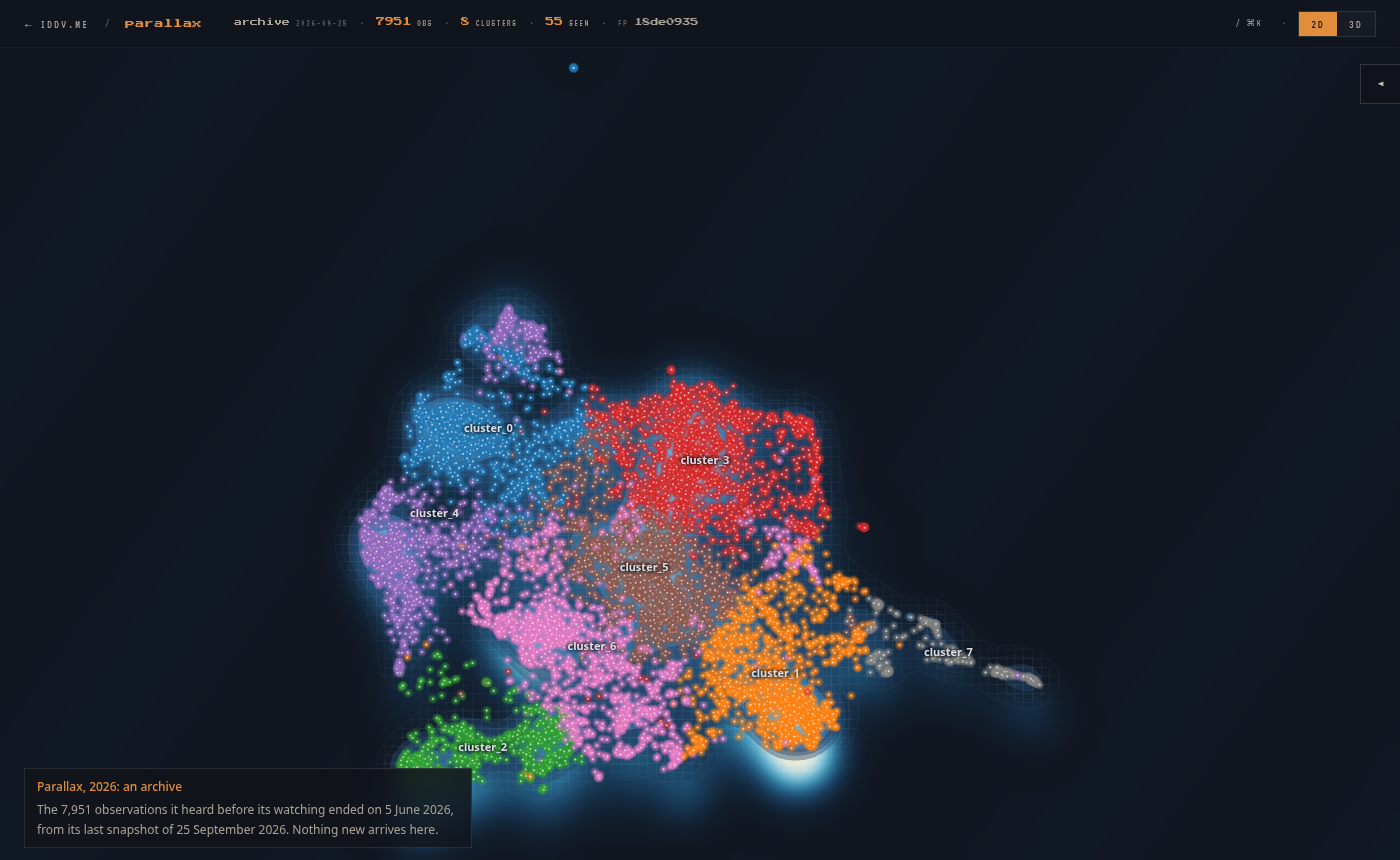
The map at /parallax. Each dot is one observation; dots close together are close in meaning. Click one there to see its nearest neighbours from any feed.
Most AI agents are called for a task, work hard for a minute and are gone. Parallax tried the opposite. Each “intern” watched one feed for months on a cheap model. It ignored almost everything it read. When a post seemed worth keeping, it wrote a short observation: a summary, one line on why it matters, and three ratings.
Every observation went into a library that is only ever added to, with its time, its source and the model’s full reply, so any line can be traced back. The bet was that some patterns only show after many weeks, across feeds that have nothing to do with each other, and that attention this cheap can afford to wait for them.
I wrote about the idea when the fleet started: The case for patient agents.
- Ran
- April to June 2026. It stopped writing on 5 June 2026.
- Watched
- Four subreddits at first, then more than 25 feeds: Reddit, Hacker News, RSS blogs, Polymarket and Anthropic's news.
- Model
- Claude Haiku through OpenRouter, every three hours.
- Left behind
- 7,951 observations in 8 clusters, last snapshot 25 September 2026.
- Source
- A private repository.
How it was built
One agent, four feeds
The first version was one intern reading four subreddits for about 17 hours. It wrote 434 observations for $1.63, and some were things I would not have noticed myself.
Ratings in parts
One score for “how strong is this” gave vague numbers. Asking separately for content quality, durability and opportunity worked better.
Meaning at write time
Each observation was embedded with nomic-embed-text-v1.5 as it was written, so it had a place in a shared space of meaning next to everything else.
Eight themes, then a correction
I first measured the library along eight themes I chose in advance. A permutation test later showed the headline number, 356 times above noise, came from a biased noise model. It fell to 1.4. The theme behind it held up.
Let the data draw the map
UMAP and k-means over the embeddings replaced my eight themes. I recognised the clusters, and at least one mixed posts from feeds that had nothing to do with each other.
Run it on a schedule
A cron job on my home server polled each feed every three hours, at most ten new posts each. Half an hour later a second job clustered the whole library again and published the snapshot this site reads.
What it wrote
A scheduled Claude agent read the latest snapshot, picked four clusters whose link was not obvious, and drafted an article from what they held. I read each draft before anything went out. These were published:
What it taught me
- Most of what it found was about the instrument, not the world. The most useful finding was a silence: the theme I cared about most stayed flat, and the reason was which feeds the fleet watched.
- Change over time was the real goal. Only one cluster, about the cost of inference, showed a change that passed every check, and that was from two snapshots six days apart.
- Every number needs something to be compared against. The first headline number came mostly from how noise was modelled, and only a permutation test showed it.
The fleet stopped writing on 5 June 2026 and I did not restart it. The map shows its last snapshot, from 25 September 2026. Nothing new arrives there.